
You left that company. Maybe a few months ago. Maybe years.
And yet this morning, walking past the building, your stomach tightened. A wave of nausea, your heart racing, your palms going clammy — and an urge to cross to the other side of the street.
You receive an email with a slightly formal subject line, and it takes you three days to open it. Your new manager makes an offhand comment, and you spend the night picking it apart, searching for what you did wrong.
This is not weakness. This is your nervous system remembering. This is trauma.
📌 Occupational PTSD: The conversation we’re not having
Post-traumatic stress disorder (PTSD) is not reserved for war survivors or victims of natural disasters. Workplace violence produces a persistent, well-documented form of anxiety: racing heart, trembling, sweating, a lump in the throat. Fear — sometimes sheer terror — on the way to work. A state of constant alertness that never fully switches off.
Clinically, both moral and sexual harassment at work generate post-traumatic symptoms. It is no longer the single, sudden shock of a violent event — it is the cumulative weight of repeated, grinding aggression that turns the workplace into a waking nightmare.
Put simply: repetition replaces suddenness. Attrition replaces shock. The result is the same.
📌 Workplace PTSD: The Condition We Rarely Talk About
Post-traumatic stress disorder (PTSD) is not exclusive to war survivors or victims of natural disasters. Workplace violence produces a persistent anxiety with well-documented physical manifestations: racing heart, trembling, sweating, a lump in the throat. Fear — sometimes terror — on the way to work. A permanent state of alertness.
Clinically, moral or sexual harassment at work generates post-traumatic disorders. It is no longer the single, sudden shock of a violent event, but the weight of repeated stressful actions that transforms the workplace into a nightmare.
In other words: repetition replaces suddenness, attrition replaces shock. With the same result.
📌 It’s Not “In Your Head”: Recognising the Symptoms
Post-traumatic stress manifests differently from person to person. Some symptoms are common and correspond to precise clinical presentations:
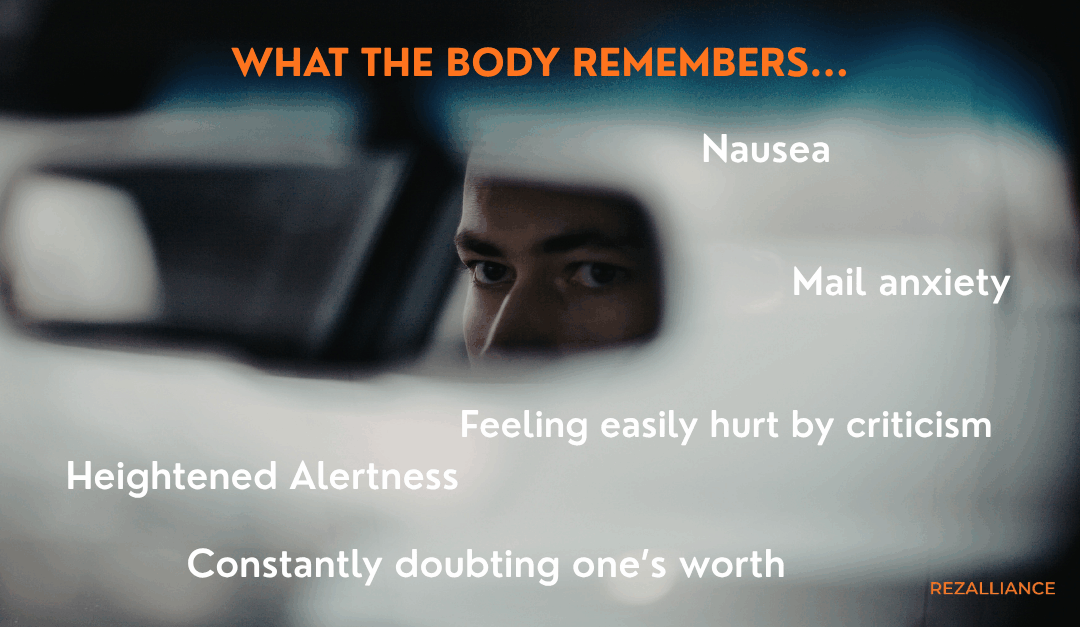
Nausea when passing the former workplace. This is a re-experiencing reaction, an intrusion mechanism. The person relives the trauma through intrusive, repetitive and overwhelming thoughts, images and physical sensations. It is as though the traumatic event were recorded on a video tape whose remote control has become hypersensitive. A building, a smell, a font can be enough to trigger these reactions.
Hypervigilance. Your brain has stayed in survival mode. It scans for weak signals, anticipates danger, never truly rests. The hypervigilance that may have protected you during the months of harassment has now become invasive in your daily life.
Hypersensitivity to criticism. An unremarkable professional comment becomes confirmation that you are incompetent, illegitimate, unwanted. Researchers Leymann and Gustafsson demonstrated that psychological harassment can lead to personality changes in the targeted person, progressively driving them toward a depressive or obsessive state, with a profound questioning of their sense of self.
Fear of correspondence. Electronic or postal. Official documents or not. Because this ordinary object became the vehicle for summons, formal notices, humiliations and petty acts of control, it is now associated with a pain one cannot bear to relive. The body reacts before the mind has even had time to read.
Constant questioning of one’s own worth. “Do I deserve my place?” “Should I have handled it better?” “What if it really was my fault?” This relentless self-questioning is not a pre-existing lack of confidence — it is a direct consequence of the trauma.
📌 The Scale of the Problem: What the Numbers Tell Us
This is not a marginal phenomenon.
In France, in 2023, more than one in three employees reported having experienced harassment at some point in their professional life. Those under 35 and women are disproportionately affected.
According to a recent survey by the CFTC-CSFV federation — conducted in response to France’s adoption of ILO Convention No. 190 on 12 April 2024 — nearly one third of witnesses and victims never report what they have experienced. And as I noted in a previous post, silence is not a sign that everything is fine. It is often a sign that fear is still present.
And what happens next? According to a Canadian study (CNESST — Commission des normes, de l’équité, de la santé et de la sécurité du travail), the average total compensation period for harassment-related injuries reaches 409 days, with even longer absences among men. This is not a lack of motivation. It is the time victims need to rebuild.
📌 To Those Who Have Lived Through It
Your suffering is real. Your reactions are normal responses to an abnormal situation.
People who have been harassed often seek help very late — months, sometimes years after the difficulties began. Determined to “hold on”, they first consulted for “stress” or sleep problems, without being able to name what was really happening.
If you recognise yourself in these lines: what you experienced was real, and it should not be minimised. Workplace harassment is an assault on your psychological integrity. It leaves marks that deserve to be treated, not ignored.
You do not have to “move on” alone. Seeking support is not a sign of weakness — it is a sign of courage. It is the first step toward rebuilding.
📌 To Leaders, HR Professionals and Health & Safety Officers
The consequences you have just read about are not inevitable collateral damage. They are the result of a failure to prevent, a failure to detect early, and a failure to respond quickly.
According to a Qualisocial study in France, 7 out of 8 companies have not implemented the measures necessary to address workplace harassment. A lack of awareness remains the primary obstacle to changing workplace culture.
Acting on all three levels of prevention means:
→ Primary prevention: Eliminating or reducing organisational risk factors before they escalate. This means building a management culture explicitly grounded in respect, creating working conditions and relationships that do not generate toxic pressure, and delivering genuine training — not tokenistic — for all employees, management included.
→ Secondary prevention: Detecting early warning signs before situations become irreversible. This means establishing independent listening mechanisms, training harassment officers to identify group dynamics, and creating safe spaces for open dialogue. Acting early to defuse tensions before they spiral.
→ Tertiary prevention: Supporting those affected. An employee in distress who develops post-traumatic stress does not recover alone, and does not recover quickly. Structured psychological support, a gradual and secure return to work, a humane management of the situation — these are what determine how deep the damage goes and how long it lasts.
The human cost is immense. So is the organisational cost: prolonged absenteeism, collective disengagement, reputational risk, legal proceedings.
- In Switzerland, according to the SECO and the Association intercantonale pour la protection des travailleurs (AIPT), psychosocial risks generate an annual cost of CHF 4.2 billion. (iva-ch.ch)
- When the full human cost is included — lost productivity, disability and long-term absence — that figure exceeded CHF 10.5 billion in 2018, representing more than 3% of GDP, according to a study conducted within the SECO framework by the Commission universitaire pour la santé et la sécurité au travail romande. (GBNews)
- Work-related stress alone costs Swiss employers an estimated CHF 7.6 billion per year. (friendlyworkspace.ch)
📌 What We Do at Rezalliance & Rez-Care.com
At Rez-care.com, we intervene across all three levels of prevention with a constructive approach designed to protect both the integrity of individuals and the reputation of organisations. Our methodology combines:
- Early detection of psychosocial risks,
- Structured prevention programmes for teams and managers,
- Support for individuals and groups in distress, and guidance through crisis resolution.
Because we understand what those affected experience — in their bodies, in their minds, and in their relationship with work — our solutions are designed to be both clinically grounded and operationally actionable.
In 2026, workplace harassment can no longer be treated as a private matter between two individuals. It is a systemic risk, one that engages the responsibility of the employing organisation — and it is time it was treated as such.
Would you like to learn more about our prevention and support programmes? Let’s talk.
Discover our solutions for healthy and equitable workplaces ⤵️
📋 Experiencing harassment at work? Take our online self-assessment.
🛟 Need personal support? Our experts are here for you.
⚙️ For organizations: Discover our custom solutions.
📡 Learn more about our public awareness work through International Day Against Harassment and for Inclusion in the World of Workhttps://24may.org/en/.